What Home Electrical Work Can You Do Yourself: A Guide to Your Home’s Electrical Supply
The age old question “What Home Electrical Work Can I doMyelf”. As a DIYer I think it’s important to know a little bit about your home electrical equipment. Especially who is responsible for each part of the system and what you can and can’t do yourself. For many people, looking at the electrical equipment in their home can be confusing. If you’ve ever wondered who is responsible for a sparking wire or a broken meter box, this guide is for you.
Watch The Video
If you want to see a video summary, check out my quick video guide below, or read on for a more detail:
Before you think about doing any home electrical work, you need to know the system demarcation. In the UK, ownership and responsibility for domestic wiring are divided between three main parties.
- the Network Operator,
- the Electricity Supplier,
- and the Homeowner.
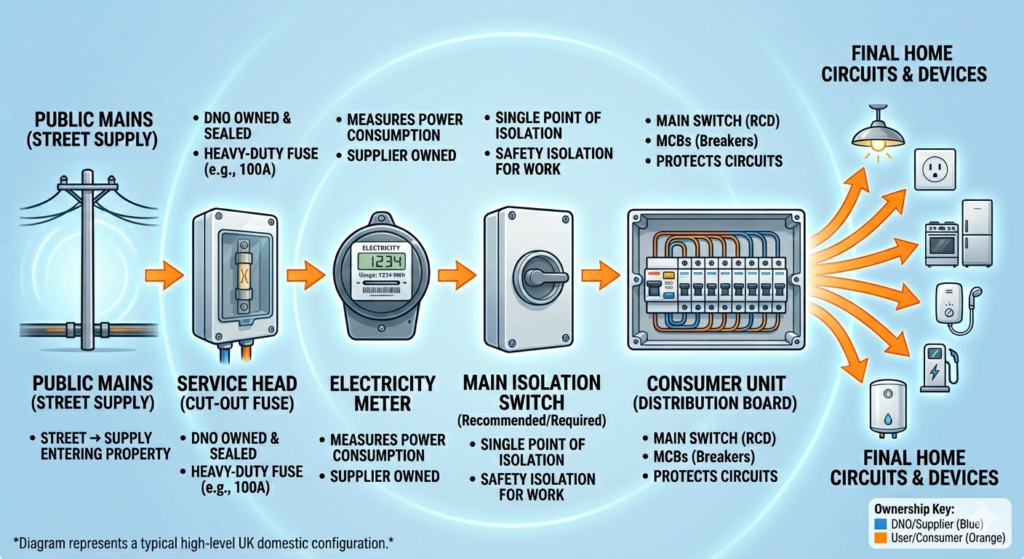
Typically, a home electrical system starts at the service head (or cut-out), which serves as the fused termination point for the incoming mains supply. This is linked via meter tails to the electricity meter. From there, the supply often passes through an isolation switch before reaching the consumer unit, which distributes power to the various safety-protected lighting and power circuits throughout the home.
1. Distribution Network Operator (DNO) – The Infrastructure
The DNO is the company that manages the cables in your street. They are not the company you pay your bills to, but they are the ones you call during a power cut (by dialing 105).
- Ownership: The DNO owns the service cable feeding the house, the main cut-out assembly, and the main fuse.
- Responsibility: They are responsible for the safety and maintenance of the equipment up to the input terminals of your electricity meter.
- Earthing: In most modern UK homes (TNC-S or TN-S systems), the DNO provides and maintains the main earth connection.
2. Electricity Supplier – The Meter
This is the company that sends you your energy bills.
- Ownership: The supplier is responsible for the electricity meter itself (though it is often technically owned by a third-party asset provider).
- Responsibility: They are responsible for the maintenance, repair, and certified accuracy of the meter.
- Smart Equipment: If you have a Smart Meter, the supplier also owns the In-Home Display (IHD)—the small screen that sits on your counter. This should stay with the property if you move out.
3. Homeowner/Consumer – The Internal System
As the homeowner, you are the “Duty Holder” for everything from the meter onwards.
- Ownership: You own the “meter tails” (the heavy cables running from the meter to your consumer unit), the consumer unit (fuse box) itself, and all internal wiring, sockets, and switches.
- Responsibility: You are responsible for all maintenance, repairs, and ensuring the system complies with Part P of the Building Regulations and BS 7671 safety standards.
- The Meter Box: While the DNO and Supplier own the contents of an external meter box, the physical box and the door are usually the homeowner’s responsibility to maintain or replace.
- Special Case (TT Systems): In some rural properties, the DNO does not provide an earth. In these cases, the homeowner is responsible for their own earth electrode (ground spike) and the cable connecting it to the house.
DIY Home Electrical Work: What Can You Do?
In the UK, DIY home electrical work is governed by Part P of the Building Regulations. While you are legally allowed to perform certain tasks yourself, the rules distinguish between non-notifiable work (which you can do freely) and notifiable work which must be done by a qualified electrician. Take a look at the regulations on the Governments website here: Part P – electrical safety
1. What You CAN Do (Non-Notifiable)
Generally, you can carry out “like-for-like” replacements and minor additions in “dry” rooms (like living rooms, bedrooms, and hallways) such as:
- Replacing accessories: Swapping out existing light switches, socket outlets, or ceiling roses for new ones.
- Replacing a damaged cable: Only for a single circuit (e.g., a bruised cable leading to a single socket).
- Adding sockets or lights: You can extend an existing circuit (e.g., adding an extra socket to a wall), provided it is not in a “special location” (kitchens are now mostly exempt in England, but bathrooms are not).
- Fitting a pre-wired appliance: Such as a plug-in oven or a ventilation fan.
2. What You SHOULD NOT Do (Notifiable Work)
By law, the following tasks must be certified by a “competent person” (a registered electrician) or notified to your local building control office:
- New Circuits: Installing a brand new circuit from the consumer unit (e.g., a new power line for an electric shower or EV charger).
- Consumer Unit Changes: Replacing or moving the fuse box.
- Special Locations: Most work in a bathroom (within “zones” near the bath or shower) or around a swimming pool/sauna.
- Outdoors: Installing new garden lighting or power that requires a new circuit.
Caution: As always, electricity is dangerous. Take appropriate precautions and if in doubt call and electrician out.
In summary
Equipment Breakdown: A to I
To help identify what is what, refer to this standard setup:
DNO Equipment (The Intake)
- A: Incoming Supply Cable: Brings power from the street into the property.
- B: Earth Connection: The point where your house connects to the DNO’s safety earth.
- C: Cut-out & Main Fuse: The primary safety limit for the whole house. Never break the seals on this.
- D: Neutral Link: A secure connection point for the neutral return.
Electricity Supplier Equipment (The Measurement)
- E: Supply Tails to Meter: The cables connecting the DNO’s fuse to the meter.
- F: Electricity Meter: Measures your usage for billing.
Customer Equipment (The Distribution)
- G: Main Earth Terminal (MET): Where all the protective earthing in your house meets.
- H: Consumer Unit Tails: The cables carrying power from the meter to your fuse box.
- I: Consumer Unit (Fuse Box): Contains the main switch and individual circuit breakers for your home.
Summary Table
| Equipment | Owner/Responsible Party |
| Street Cable & Main Fuse | DNO |
| The Meter & Smart Display | Supplier |
| Meter Box (External Case) | Homeowner |
| Fuse Box, Wiring & Sockets | Homeowner |
| Earth Spike (if no DNO earth) | Homeowner |
DIY Home Electrical Work: FAQs
Q. What is the difference between an Electricity Supplier and a DNO?
A: Your Electricity Supplier is the company you choose to buy your energy from and who sends you your monthly bills (e.g., British Gas, Octopus Energy, E.ON). They are responsible for your meter.
Your Distribution Network Operator (DNO) is the company responsible for the actual physical infrastructure—the underground cables, pylons, and substations in your geographic area. They own the main fuse coming into your property, and they are the ones you call on 105 if you have a power cut.
Q. What happens if I do notifiable electrical work without certifying it?
A: Carrying out notifiable work without involving Building Control or a registered electrician is a breach of Building Regulations. This can result in a significant fine from your local authority. More commonly, it creates massive headaches when you try to sell your home, as the buyer’s solicitor will ask for Part P electrical installation certificates. Lack of certification can also potentially void your home buildings insurance if a fault causes a fire.
Q. Is a downstairs cloakroom/toilet considered a “bathroom”?
A: Under UK Wiring Regulations (BS 7671), a downstairs cloakroom containing only a toilet and a washbasin is not classified as a “special location” (which is a room specifically containing a bath or a shower). Therefore, it does not carry the strict zone restrictions or automatic notification requirements of a full family bathroom.
Q. Can I install outdoor lighting myself if it uses 12V or 24V DC and connects to a second consumer unit?
A: This depends entirely on where the mains voltage (230V) ends and where the extra-low voltage 12V or 24V) begins:
Notifiable: If you are running a brand-new 230V circuit from the consumer unit to power an outdoor transformer, this is notifiable.
Non-Notifiable: If you plug a 12V or 24V transformer into an existing garage socket, or wire it into an existing fused spur, the low-voltage outdoor cabling itself is non-notifiable. Under Part P rules in England, extending an existing circuit for outdoor lighting is allowed without notification, provided you aren’t running a completely new line back to the fuse box.
Q. If I have a second consumer unit (e.g., in a garage) and I completely isolate it, can I legally add a new circuit myself?
A: Legally, no. Even if you completely isolate the garage consumer unit from the mains supply while you work on it, installing a brand-new circuit is still classified as notifiable work under Part P of the Building Regulations.
The regulations focus on the outcome of the work, not just your safety while installing it. Because you are introducing a new protective device (circuit breaker) and running a new circuit that didn’t exist before, it must be inspected, tested, and certified. You will either need a registered self-certifying electrician to do the job or notify Local Authority Building Control before you start.
Q. I live in Scotland/Wales. Do these exact same DIY rules apply to me?
A: Not entirely. The guidance in this article primarily reflects Part P of the Building Regulations for England.
In Wales: The rules are stricter. For example, any electrical work in a kitchen (even extending an existing circuit to add a socket) is still classified as notifiable work.
In Scotland: They do not use Part P; instead, they operate under the Scottish Building Standards. Many types of work require a “Building Warrant” before you start unless carried out by a registered installer. Always check your specific home nation’s building control rules before starting.
Q. Can I change a light switch or socket faceplate if my house has old wiring colors (red and black)?
A: Yes, you can do a “like-for-like” swap of a damaged or outdated faceplate, even if your house uses the old pre-2004 wiring colors. However, you must make sure you match the connections correctly:
Old Red (Live) connects to the new Brown (or terminal marked L).
Old Black (Neutral) connects to the new Blue (or terminal marked N).
Bare Earth wires must always be sleeved with green-and-yellow insulation and connected to the earth terminal (E).
Q. If I buy a smart light switch that requires a Neutral wire, but my existing switch doesn’t have one, can I drop a Neutral wire down from the ceiling rose?
A: Technically, extending a lighting circuit in a dry room is non-notifiable, so you are legally allowed to do it yourself. However, “dropping a neutral” requires a solid understanding of how your specific lighting circuit is looped (loop-in at the ceiling rose vs. looping at the switch). If you choose to do this, ensure the circuit is fully isolated, the new cable is correctly sized and routed through safe zones in the wall, and the structural integrity of your ceiling joists or walls isn’t compromised.
⚠️ Disclaimer: While minor, non-notifiable electrical alterations are legal to do yourself, all electrical work in the UK must comply with the safety standards of BS 7671. If you do not have the specialized, calibrated test equipment required to verify that your earthing and trip times are safe, always consult a qualified professional.
Further Reading
- Professional Junction Boxes: Building with DIN Rail Terminal Blocks (UK Guide)
- How to Wire a Wall Socket Correctly (Step by Step Guide)
- How to Fit an Electric Socket Blanking Plate: A Clean & Safe DIY Guide
- How to Change a Double Wall Socket (UK): A Step-by-Step DIY Guide
- Why You Need Wire Ferrules for the Best Crimp Connections
Subscribe Now!
If you found this DIY Home Electrical Work helpful and are ready to stop guessing and start troubleshooting your own tech and smart DIY, head over to the Built By Pete YouTube channel! We’ve got hundreds of other DIY projects and smart home tutorials. Click here to subscribe and hit the notification bell so you never miss out on the tips, tricks, and step-by-step guides that will simplify your tech life.